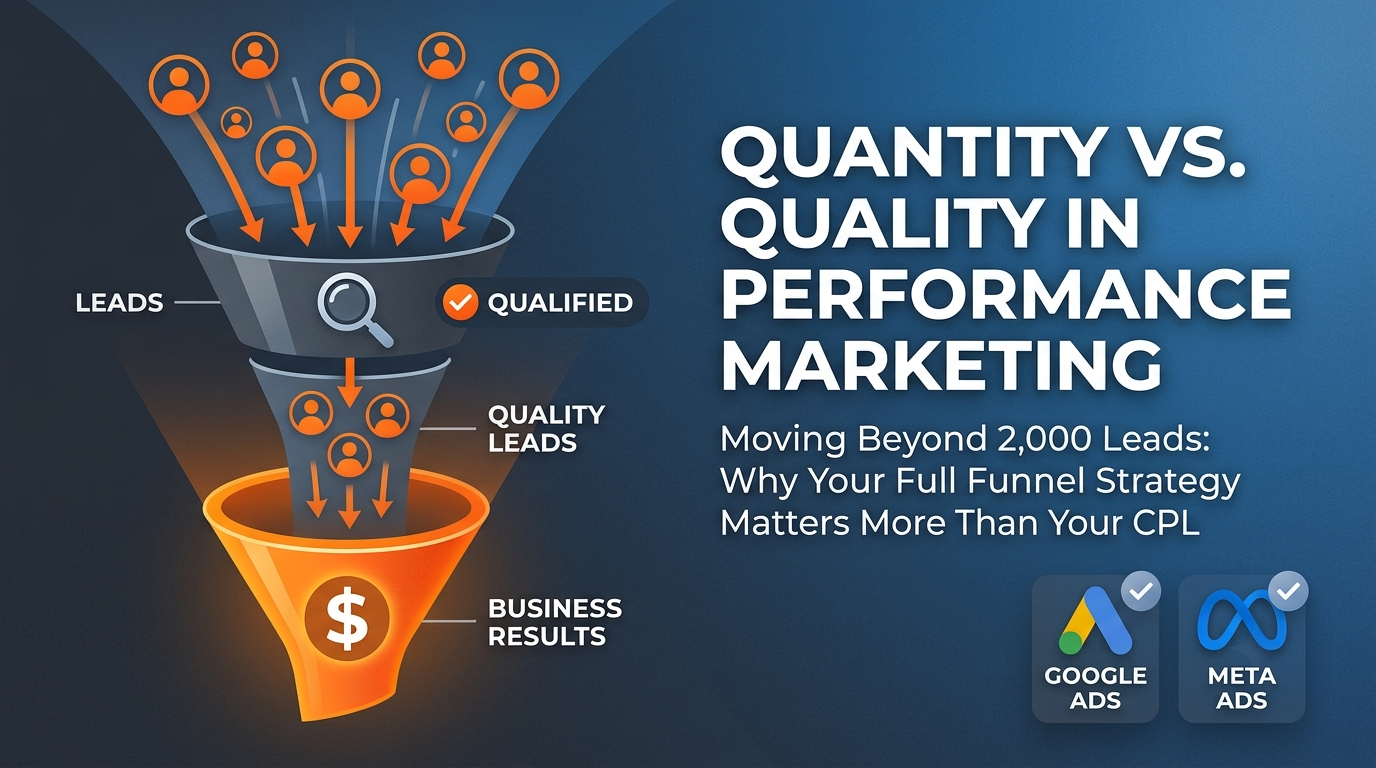
"We generated 2,000 leads this month!"
On paper, a claim like that sounds like an overwhelming success. In client meetings and team syncs, high-volume metrics often trigger immediate applause. But as anyone who has managed large-scale campaigns knows, a follow-up question usually lingers in the minds of sales reps and business leaders:
How many of those leads are actually qualified?
One of the most valuable lessons I’ve learned in digital marketing is that generating leads is only half the battle. A campaign can produce hundreds or even thousands of form submissions and still fail to deliver meaningful business results.
If your marketing strategy stops at lead capture, you aren't doing performance marketing—you're just running ad campaigns.
The Complete Funnel Approach
To bridge the gap between advertising spend and bottom-line growth, performance marketing must take accountability for the full customer journey. Optimizing purely for top-of-funnel metrics creates a dangerous disconnect between marketing and sales goals.
Instead, an effective performance strategy evaluates four distinct stages of the funnel:
1. Reach (Targeting Precision)
Are we reaching the right audience?
It’s easy to buy cheap traffic, but impressions mean nothing if your ad is being served to users who have zero intent or budget to purchase your offering.
2. Lead Generation (Initial Engagement)
Are people genuinely interested in the service?
High click-through rates and form fills indicate that your value proposition resonates. However, if the friction on your landing page is too low, you risk attracting curiosity seekers rather than real buyers.
3. Lead Qualification (Relevance & Readiness)
Are the leads relevant and sales-ready?
This is where campaigns win or lose. Filtering leads through proper lead scoring, qualifying questions, and clear parameters ensures your sales team spends their time on opportunities with real potential.
4. Conversion (Business Impact)
Are marketing efforts translating into real business opportunities?
The ultimate metric is revenue. Performance marketing must connect directly to pipeline growth, closed-won deals, and customer acquisition cost (CAC).
Lessons from Managing High-Volume Campaigns
In my experience managing large-scale performance campaigns, I’ve overseen monthly volumes exceeding 2,000 leads while consistently maintaining a Marketing Qualified Lead (MQL) rate above 40%.
Achieving these numbers isn't about finding a magic growth hack—it's about shifting focus.
High lead volumes are only meaningful when viewed alongside:
Lead Quality: What percentage of leads meet your Ideal Customer Profile (ICP)?
Follow-up Processes: How fast and effectively is the sales team reaching out to incoming leads?
Conversion Rates: How many MQLs transition into SQLs (Sales Qualified Leads) and active deals?
Business Objectives: Are these campaigns contributing to sustainable Customer Lifetime Value (LTV)?
Stop Optimizing Only for Cheaper Leads
The drive to lower Cost Per Lead (CPL) is one of the most common traps in digital marketing. When you optimize campaigns solely to decrease CPL, algorithm networks (like Google Ads and Meta Ads) will naturally find the path of least resistance—often delivering lower-intent users who submit forms easily but never convert.
My approach to performance marketing is simple: Don't optimize campaigns only for cheaper leads. Understand and optimize for what happens after the lead is generated.
The real value of performance marketing lies in connecting your advertising spend directly to actual business outcomes. A higher CPL for an audience that converts at 15% is infinitely more valuable than a low CPL for an audience that converts at 1%.
Final Thoughts: What Metrics Matter to You?
To build campaigns that drive actual business value, performance marketers must look beyond surface-level metrics and align closely with sales feedback and revenue data.
If you run or manage performance marketing, I'd love to hear your perspective: Which metric do you prioritize most in your campaigns—CPL, MQL rate, or overall conversion rate? Let's discuss in the comments below.